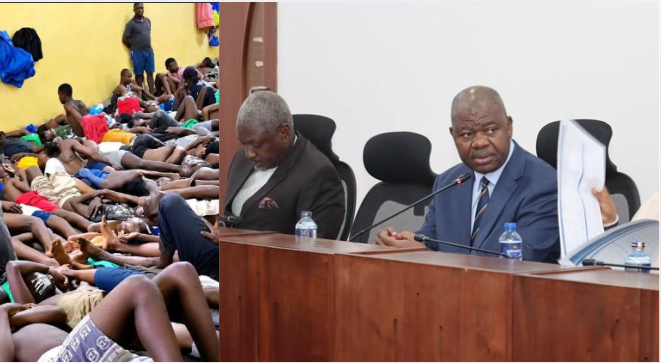
The disturbing images of remandees crammed into holding cells at Nairobi’s Industrial Area Remand Prison have brought Kenya’s prison conditions under renewed scrutiny, with Parliament now calling for urgent intervention and broader reforms to reduce the number of people held behind bars.
The Justice and Legal Affairs Committee (JLAC), chaired by Gitonga Murugara, wants the facility upgraded immediately and prisons across the country decongested. The committee’s position follows the circulation of a video showing remandees lying on the floor in severely overcrowded cells, with some seemingly having little room to stretch or move.
The footage triggered public outrage, with questions raised about the dignity, safety and basic welfare of people held in the country’s correctional facilities. For many Kenyans, the images were a troubling reminder that prison overcrowding is not simply an administrative problem but a human rights concern.
Speaking during a meeting with Principal Secretary for Correctional Services Dr Salome Beacco on Tuesday, November 24, Murugara described the footage as disturbing and called for urgent measures to improve conditions at the facility.
“That video was very disturbing and there is an urgent need to have that facility decongested for more humane treatment of the remandees,” he said.
The committee wants the National Council on the Administration of Justice (NCAJ), chaired by the Chief Justice, to bring together relevant justice-sector agencies and develop a framework for legal reforms. It also resolved to arrange a meeting between the Chief Justice and correctional services officials to consider practical ways of reducing the prison population, particularly among petty offenders.
Beacco informed the committee that upgrading Industrial Area Remand Prison was already among the State Department’s priority budget proposals for the 2027 financial year. She attributed the growing pressure on correctional facilities to an increase in the number of offenders nationwide.
According to the figures she presented, the country currently has 64,542 custodial offenders and 61,904 non-custodial offenders, compared with 62,000 and 59,756 respectively in the previous year. She warned that the growing population was placing additional pressure on existing resources without a corresponding increase in funding.
The department has been allocated KSh45.72 billion against a requirement of KSh75.365 billion, representing approximately 61 per cent of its requested budget. Beacco said additional funding was necessary for essential operations, including vehicles to transport prison officers and inmates between facilities and courts, as well as probation and aftercare services.
Unlike convicted prisoners, remandees are accused persons awaiting trial or the conclusion of legal proceedings. Their detention does not amount to a finding of guilt. Article 49 of the Constitution provides for the right to reasonable bail or bond conditions, unless compelling reasons justify continued detention. It also prohibits remand for offences punishable only by a fine or imprisonment of six months or less.
The debate now extends beyond prison accommodation to the treatment of suspects from the moment of arrest. Concerns about police custody, access to legal representation, delayed court appearances, expensive bail terms and prolonged trials all form part of the wider conversation. A person may technically qualify for release but remain behind bars because they cannot raise the required amount.
There are already efforts to address the problem. The Judiciary’s 2025/2026 annual report shows that High Court decongestion exercises conducted across 48 court stations between October and December 2025 reviewed 1,725 cases and resulted in the release of 1,329 inmates.
The latest outcry should therefore become an opportunity to move beyond emergency interventions. Faster case processing, regular reviews of remand cases, reasonable bail conditions, wider use of probation and community service and alternatives to detention for petty offences could help reduce unnecessary imprisonment.