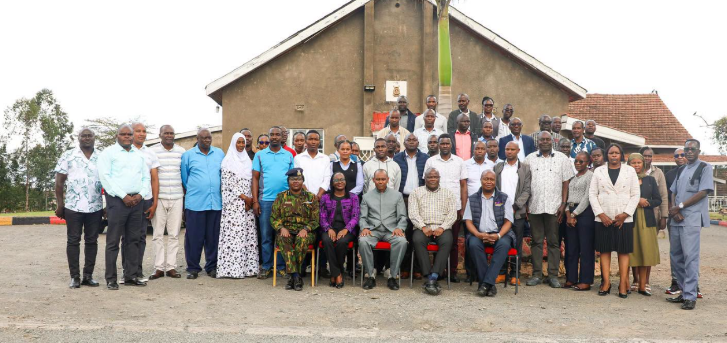
180 Kenyan Police officers were mandated to serve as internal guardians of integrity within their respective commands following a 19-day Integrity Assurance Officers’ (IAO) training course in Nakuru County. The training began on November 2, 2026, and closed on November 20, 2026, and was held at the Nakuru Police Regional Training Centre.
In a statement issued by the National Police Service on Saturday, November 21, 2026, the course was developed under the Programme for Legal Empowerment and Aid Delivery in Kenya (PLEAD II) initiative, with vital technical and financial backing from the European Union (EU) and the United Nations Office on Drugs and Crime (UNODC).
The three-week, multi-regional capacity building initiative was aimed at strengthening internal accountability and ethical policing as well as strategically ramping up efforts to promote transparency, upholding of the rule of law and instilment of a culture of integrity across the Police Service.
The programme was conducted across three key regional headquarters including Kisumu, Mombasa and Nakuru Cities. It was spearheaded by the Inspector General of Police, Mr. Douglas Kanja and delivered through close collaboration with the Ethics and Anti-Corruption Commission (EACC), the National Integrity Academy (NIA) and the Kenya Ethics and Anti-Corruption Academy (EACA).
Presiding over the closing ceremony on behalf of the Inspector General, the NPS Director of Training and Research, Mr. Hassan Aljir, AIG, accompanied by the UNODC Programme Management Officer, Ms. Joy Matara, commended the graduating officers for their commitment to ethical service.
Mr Aljir also commended the EACC for designing a curriculum anchored in Chapter Six of the Constitution of Kenya, national laws and the daily operational realities of policing. He also appealed to the UNODC and EACC for sustained collaboration beyond the classroom, calling for continuous mentorship, refresher courses and joint monitoring mechanisms to ensure that the principles of integrity take root throughout the National Police Service.
The Kenya Police Service has consistently featured among the country’s most corruption-prone public institutions, with several national surveys highlighting bribery as a persistent problem in interactions between officers and the public.
The Ethics and Anti-Corruption Commission’s 2024 National Ethics and Corruption Survey found that 48.2 per cent of respondents identified the National Police Service as the government institution most prone to corruption. Similarly, Transparency International Kenya’s 2025 Bribery Index ranked the police as the worst-performing institution in terms of bribery, ahead of land services and motor vehicle licensing.
The consequences are often borne by ordinary Kenyans, who may be asked for money to avoid traffic penalties, secure police assistance or have complaints addressed. Such practices make access to justice more expensive, disproportionately affect low-income citizens and undermine public confidence in law enforcement. Efforts to address these problems have included strengthening internal accountability, investigating officers implicated in bribery and reviewing police procedures that create opportunities for corruption.
In February 2025, the EACC launched an examination of the National Police Service’s systems, policies and operational procedures to identify loopholes that facilitate graft, with recommendations expected to guide institutional reforms. The Independent Policing Oversight Authority also provides an external channel for investigating complaints against police officers, while the National Police Service has internal accountability structures, including its Internal Affairs Unit.