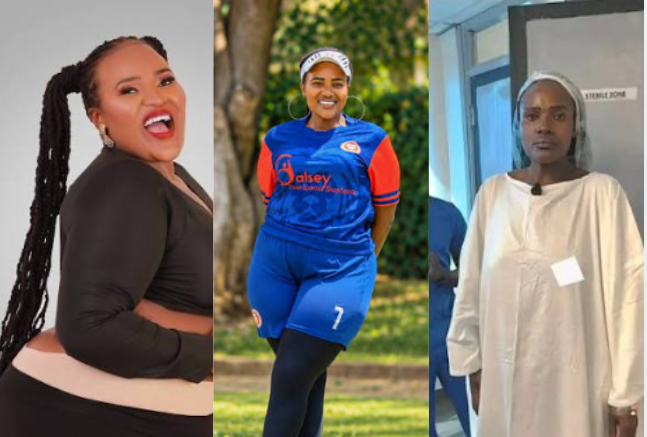
To own her body size story in a world where slim is more validated, Kenyan actress Sandra Dacha often referred to herself as ‘The Biggest Machine’ as a bold, body-positive moniker to embrace her larger-build physical presence.
But it would appear the era of The Biggest Machine has now come to an end after she unveiled details of her latest big, weigh-loss surgery she had done at a city hospital in Nairobi.
Taking to social media on Monday, November 9, 2026, in a ‘keep-up-with-me’ style short vlog, she counted down the days and minutes to the surgery in which she finally revealed she had undergone a Gastric Sleeve Surgery, medically referred to as a Vertical Sleeve Gastrectomy (VSG).
“On 30th September 2026, I underwent Gastric Sleeve Surgery. That emotional moment was real. I was scared, overwhelmed, hopeful and uncertain about what lay ahead. It was a big decision, and I knew I was stepping into a new chapter of my life. For those who have followed my weight-loss journey, you know how far I have come. This surgery was another important step in that journey…” said Ms Dacha in part.
According to the Cleveland Clinic, VSG is a surgery procedure in which a large portion of the stomach is removed, leaving behind a narrow ‘sleeve’. This helps the stomach restrict calories and reduce hunger signals.
“This surgery is offered to help people with clinically severe obesity achieve effective weight loss. The gastric sleeve operation removes about 80% of the stomach, leaving behind a tubular “sleeve,” about the size and shape of a banana,” said the Cleveland Clinic on their official website.
This procedure does the following things:
- Reduces the size of the stomach to restrict the amount of food one can eat in one sitting, making one feel fuller faster.
- It reduces the amount of hunger hormones that the stomach can produce. This helps to decrease one’s appetite and cravings and may help to prevent the impulses that cause people to regain the weight they’ve lost.
Gastric sleeve surgery can improve and sometimes eliminate diseases, including insulin resistance and Type 2 diabetes, hypertension, hypertensive heart disease, high cholesterol, non-alcoholic fatty liver disease and obstructive sleep apnea.
The surgery is touted to take between 60 and 90 minutes, and hospital stay of two days to monitor and manage pain and temporary side effects of the surgery if no complications such as bleeding, infection, leaking staple lines or reactions to anesthesia arise.
“Most of the time, a sleeve gastrectomy is done by laparoscopic or robotic surgery. That means that instead of making a large incision (or cut) to open your abdominal cavity to access your organs, your surgeon will perform the operation through small incisions. This makes for an easier recovery, but some people may be better served by open surgery, depending on their conditions,” the Cleveland Clinic further explained on their website.
It is also advised that before one can return to feel like themselves or working at full capacity, they should wait a minimum of four weeks for the body to recover and adjust.
The average cost of this surgery in Kenya ranges between Ksh 750,000 and Sh 1,200,000.
Ms Dacha’s revelations come days after photos of her emerged looking emaciated and sickly while dressed in a surgery gown. These images prompted negative speculations that her previous weight loss procedure- injecting Ozempic in 2023, had caused the deterioration of her health. The same images were also used to warn people against quick weight loss procedures.
Ms Dacha did not comment on the wild speculations and simply proceeded to later release videos of her VSG pre-operation activities- which included the initial ’emaciated’ image of herself- and the hours after the procedure was done.