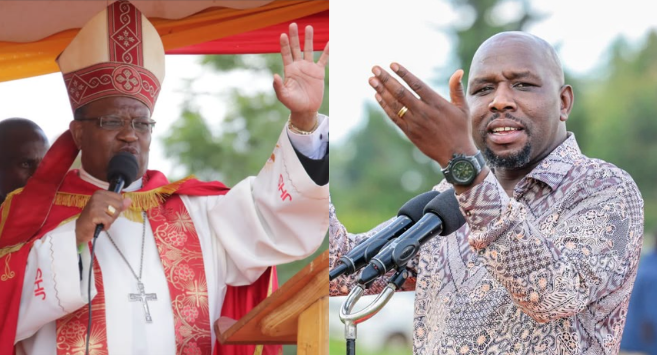
The question of whether churches should accept large donations from politicians has returned to the national conversation after Archbishop Anthony Muheria and Interior Cabinet Secretary Kipchumba Murkomen disagreed over political money in religious institutions.
The exchange comes as Kenya approaches the 2027 General Election, when politicians increase public appearances, attend church services and contribute to community projects. Fundraisers have become occasions for leaders to announce sizeable pledges before congregations and cameras. The timing makes the question especially sensitive for voters and church members.
Muheria, the Archbishop of Nyeri, urged churches not to invite politicians to fundraising events. He argued congregations should finance projects through members’ contributions rather than depend on influential benefactors.
“We do not need politicians. Do not invite politicians to our fundraisers. We can manage on our own as Christians,” Muheria said.
The Archbishop was concerned about large sums announced publicly during services. Donations of Ksh500,000 or even Ksh1 million, he argued, could create a sense of obligation. His stance was that churches receiving substantial political support may find it harder to question a donor’s conduct or speak independently on national issues.
Archbishop Muheria said politicians who genuinely wished to support church projects should contribute through ordinary collection channels, like other worshippers, rather than make high-profile pledges at the pulpit. He cited the construction of Nyadha Plaza as a project Christians completed through their own contributions.
Mr Murkomen challenged the Archbishop’s position, questioning why politicians should be treated differently from other members of society. Speaking at an interdenominational service in Marioshoni, Molo, on November 22, the Interior Cabinet Secretary argued elected leaders are also Christians who need spiritual guidance and should be free to support religious projects.
“Why is that Bishop condemning people who are in politics? He has not condemned farmers, engineers, lawyers, doctors or people doing business. But he is targeting politicians,” Murkomen said.
He questioned whether politicians were being excluded despite needing the same spiritual support as other worshippers.
“We need bishops, we need pastors, we need to be ministered to. We need to go to church,” he added.
Murkomen called the proposal “really regressive”, arguing politicians should not be barred from contributing because of their profession.
At the center of the disagreement was the difference between genuine giving and the influence that may accompany a donation. A contribution made freely and without conditions is not necessarily the same as a public pledge attracting publicity and political visibility.
That said, the question remains, “Can churches accept money without creating expectations of access, endorsement or silence?”
The debate follows a separate directive by the Kenya Conference of Catholic Bishops on November 12, barring political addresses in Catholic churches ahead of the 2027 elections.
Archbishop Muheria said politicians have other platforms for communicating their messages, including the media, public barazas (gatherings) and roadside rallies.
“People come to places of worship to find inner peace,” he said, noting that supporters of opposing parties worship together.
Religious institutions continue to face a balancing act as the 2027 General Election campaign period approaches. Rejecting every donation from a politician could exclude a worshipper giving in good faith. Accepting large sums without safeguards, however, would raise questions about transparency and independence. Clear donation policies, proper records and consistent rules for contributors are often set up to help protect public trust.
The issue is bigger than whether politicians should give millions to churches. It is whether religious institutions can receive support without becoming indebted to donors. As election activity gathers pace, Kenyans are left to consider- should churches welcome every contribution or should some money come with questions too important to ignore?