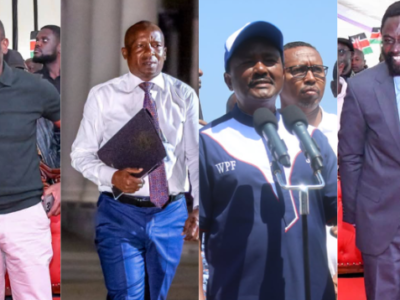
Siaya Governor James Orengo accused President William Ruto of presiding over an economy in which one individual appears to benefit from almost every major commercial opportunity, reigniting debate about alleged conflicts of interest between public office and private business.
Speaking in Alego Usonga on Thursday, November 26, 2026, Orengo questioned how ordinary Kenyans could compete in an economy where, according to him, businesses supplying essential construction materials and public institutions handling money were allegedly connected to the Head of State.
“It cannot be that in an entire nation, one man ends up feeding off every single resource we have. Buy cement, it goes to Ruto. Buy steel, it goes to Ruto. When public institutions bank their money, it all flows to his bank, before you even touch insurance,” Orengo said.
He further questioned the government’s commitment to equality, invoking the slogan associated with Ruto’s administration.
“You cannot preach water and drink wine. Where is ‘Usawa Ni Sawa’ in all of this?” he posed.
The governor also claimed that residents of Alego Usonga had rejected what he described as excessive greed, declaring their political position as “WANTAM!”
Orengo’s remarks add to a series of accusations by politicians, including some who previously worked closely with Ruto, over his alleged commercial interests and the potential influence of those interests on public policy.
One of the most outspoken critics has been former Deputy President Rigathi Gachagua, who repeatedly accused Ruto of using the presidency to advance private commercial interests.
On September 11, 2026, while addressing Kenyans living in Portland, Oregon, Gachagua accused the President of dominating several sectors of the economy.
“There’s no money in circulation, and business is not thriving because the country has been taken over by what we call state capture. William Ruto is doing all the businesses in the country,” he said.
He proceeded to list sectors in which he alleged the President had interests, including banking, insurance, healthcare, steel, cement, tiles, education, ICT, public transport and police uniform supplies.
“He literally has driven all Kenyans out of business,” Gachagua declared.
Kiharu MP Ndindi Nyoro also questioned the President’s alleged interests in commercial transactions involving public institutions.
In October 2026, Nyoro accused the government of exposing public funds, including pension-related institutions, to financial losses through the purchase and subsequent sale of Kenya Pipeline Company shares.
“The public funds bought the shares at the IPO for Sh9 each and sold them at the same price, losing money if you factor in the brokerage commissions,” he alleged.
He questioned whether individuals connected to the President benefited from the transaction, including through an investment bank associated with him.
“We are talking about a company whose shares led to Pensioners losing money while a leader made money,” Nyoro further claimed.
The MP also questioned the ownership of companies involved in the petroleum value chain, including the government-to-government fuel arrangement and the proposed Dangote refinery investment.
At the center of the debate is the question of whether leaders with private commercial interests can adequately protect public resources and guarantee fair competition.
Kenya’s conflict-of-interest framework requires public officers to avoid situations where private interests conflict with their official responsibilities. The issue is therefore not simply whether a politician or their family owns a business, but whether public authority, access to government resources or official decisions are used to advance private interests.
Orengo’s remarks in Alego Usonga have consequently brought the issue back into the political conversation: can an economy offer equal opportunities when concerns persist about the relationship between political power and private wealth?